AI Workflows for Manufacturing Process Automation
"My factory runs on spreadsheets made 30 years ago." If that quote from a manufacturing forum landed like a gut punch of recognition, you're not alone. Across factory floors worldwide, operations managers and IT directors are caught between leadership pushing for AI-driven efficiency gains and the reality on the ground: decades-old ERPs, disconnected machines, and data quality problems that make any serious AI initiative feel like building a house on sand.
The good news? A rip-and-replace strategy isn't your only option — or even a realistic one. The smarter path is deploying AI workflows that act as an intelligent layer on top of your existing systems, connecting your MES, ERP, and legacy infrastructure to modern AI capabilities without requiring you to throw out what already works.
This guide covers the complete AI automation stack for manufacturing operations: predictive maintenance, quality control, production planning, supply chain optimization, and worker safety — with the integration architecture and security requirements that enterprise manufacturers demand.
Key facts driving urgency:
- 70% of software in Fortune 500 companies is over two decades old — the integration gap is the primary barrier to AI adoption in manufacturing
- AI-driven predictive maintenance can reduce unplanned downtime by 30–50% and cut maintenance costs by over 25%
- AI-powered quality control can reduce defect rates by 40%+ and inspect up to 10,000 parts per hour
- Production planning AI workflows can improve efficiency by up to 30% and significantly reduce machine idle time
- Companies using AI for supply chain optimization have reported inventory turnover improvements of up to 73%
1. Why Manufacturing AI Automation Is No Longer Optional
The manufacturers winning in the next decade aren't the ones replacing everything — they're the ones building smarter connections between what they already have. But the status quo is expensive. Unplanned downtime can cost anywhere from $36,000 per hour in FMCG to $2.3 million per hour in automotive. Manual quality inspection misses defect that AI catches in milliseconds. Production schedules built in spreadsheets are obsolete before they're issued.
The frustration on manufacturing floors is real and valid: "AI isn't bad at all." It's just being used horrendously." The problem isn't the technology — it's the deployment approach. Generic chatbots that don't know your machines, AI tools that require clean data nobody has, and automation projects that speed up a subprocess without improving the overall outcome.
The right approach to manufacturing AI automation starts with the friction — identifying where data is fragmented, delayed, and manually reconciled — and builds targeted workflows that eliminate that friction without disrupting the systems that keep production running. That's the difference between AI that delivers ROI and AI that delivers a presentation.
2. The Core Challenges in Manufacturing AI Adoption
The Legacy System Integration Problem
Most manufacturing environments run on brownfield infrastructure — a mix of modern and legacy systems that were never designed to talk to each other. Older ERP systems like SAP and Oracle instances store data in formats that are difficult for AI models to ingest. Many legacy machines lack the APIs that modern software depends on. And cleaning up ERP data is, as one manufacturer described it, "my side hustle" — a constant background task that never quite gets done.
The solution isn't to replace these systems. It's to wrap them in a modern API layer that makes their data accessible to AI tools without touching the core. Your legacy ERP doesn't need to "know" about AI — it just needs to fire a scheduled call to a workflow endpoint, and the workflow handles the rest.
Data Quality and Readiness
AI is only as good as the data feeding it. "Everybody says they want AI, but when you look under the hood, half the companies aren't even collecting clean data." Before deploying any AI workflow, a data readiness audit is essential: identifying what data exists, where it lives, how clean it is, and whether it'saccessible via API or requires extraction.
This isn't glamorous work. But it's the foundation that determines whether your automation investment delivers or disappoints. Starting with a narrow, well-understood data set — sensor readings from one production line, maintenance logs for one class of equipment — is consistently more successful than trying to integrate everything at once.
The Human Adoption Challenge
Even the best-designed AI system fails if operators and managers don't use it. "There is so much opportunity to bring AI systems to the table in manufacturing, but they have to be unbelievably simple." The interface matters as much as the intelligence. Workers on the factory floor won't navigate dashboards or log into new systems — they need AI to surface the right information in the tools they already use.
3. Predictive Maintenance Automation
Unscheduled downtime is every plant manager's nightmare. Traditional maintenance approaches — either reactive (fix it when it breaks) or preventive (fixed calendar schedules) — are both expensive in different ways. Predictive maintenance uses AI to schedule maintenance precisely when it's needed, based on actual machine health rather than time elapsed.
How Predictive Maintenance Workflows Work
A production-grade predictive maintenance workflow connects IoT sensors on critical machinery to an AI model that continuously analyzes real-time data — vibration patterns, temperature, pressure, output variance — and generates failure probability scores. When the score crosses a defined threshold, the workflow automatically:
- Creates a high-priority work order in the CMMS
- Checks technician availability and schedules maintenance during the next planned production stop
- Sends notifications to relevant personnel via Slack or email
- Updates the production schedule to account for the maintenance window
This shifts maintenance from reactive firefighting to data-backed planning. Companies deploying predictive maintenance report a 50% reduction in unplanned downtime, up to 70% fewer unexpected breakdowns, and maintenance cost reductions of over 25%.
Real-World Results
BMW Group implemented AI to analyze fault patterns at their Regensburg plant, saving more than 500 minutes of production disruption annually. Jubilant Ingrevia cut equipment downtime by over 50% using AI-driven algorithms. The ROI of predictive maintenance comes from avoiding a few critical breakdowns per year — not from perfect predictions everywhere.
Here is what a production quality alert workflow looks like in Jinba Flow — AI classifies the defect type and severity, routes by criticality, runs root cause analysis, and logs every action for compliance:
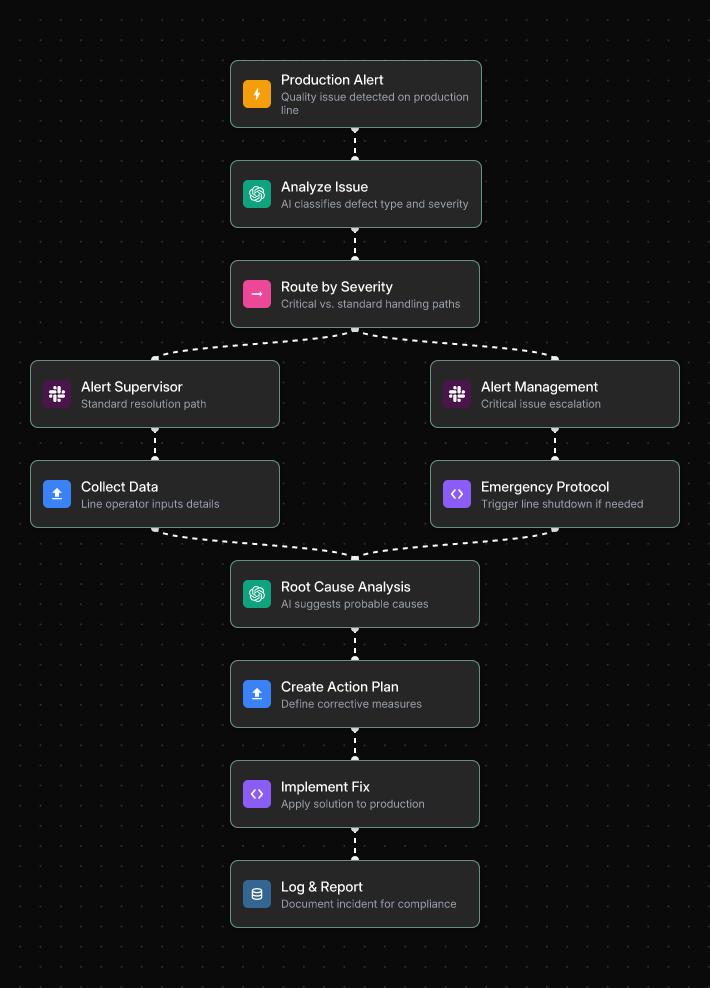
Standard issues route to the line supervisor for data collection and corrective action. Critical issues trigger management escalation and emergency protocol automatically — ensuring the right people are notified within seconds of detection, not minutes
Implementation Considerations
Start with your highest value, most failure-prone equipment. The workflow needs clean baseline sensor data to detect anomalies meaningfully — invest in data quality before expecting AI results. The MQTTprotocol handles the lightweight, real-time streaming from OT systems efficiently. A workflow orchestration platform deploys the full pipeline as a production-ready API, so your legacy MES can call it without modification.
→ See also: 7 Ways AI Automation is Transforming Manufacturing Workflows in 2026
→ See also: 10 Ready-to-Deploy Industrial AI Solution Workflows for Manufacturing
4. Quality Control Automation
Manual inspection at production speed is a losing battle. Human fatigue, inconsistency, and sheer volume mean defects slip through — costing you in scrap, rework, and customer returns. AI-powered quality control catches defects that human inspectors miss; at speeds no manual process can match.
Computer Vision for Defect Detection
AI vision systems analyze product images on the assembly line in milliseconds, detecting surface defects, dimensional errors, and assembly issues with greater speed and accuracy than manual inspection. Defect detection accuracy now exceeds 90%, and these systems can inspect up to 10,000 parts per hour.Real-world results: BMW reduced defect rates by 30% a year after deploying AI-powered camera systems. Beko achieved a 66% reduction in defect rates in their sheet metal forming process. In electronics manufacturing, AI image recognition has saved $1 million annually through improved product yield.
Connecting Vision Systems to Operations
The vision system is only the first step. When a defect is detected, an automated workflow needs to:
- Log the defect type, location, and timestamp in the quality management system
- Trigger diversion or quarantine of the defective part
- Alert the QC team with the defect image for review
- Analyze defect trends and notify the QA manager when patterns emerge
This connection between the vision system and downstream operations is where workflow automation delivers its value. Without it, defect data sits in a dashboard nobody checks. With it, every detection triggers a coordinated response.
The following workflow shows how a quality control event is handled end-to-end in Jinba Flow — pulling production records from the ERP, routing by severity, and escalating line halt decisions to the plant manager when required:
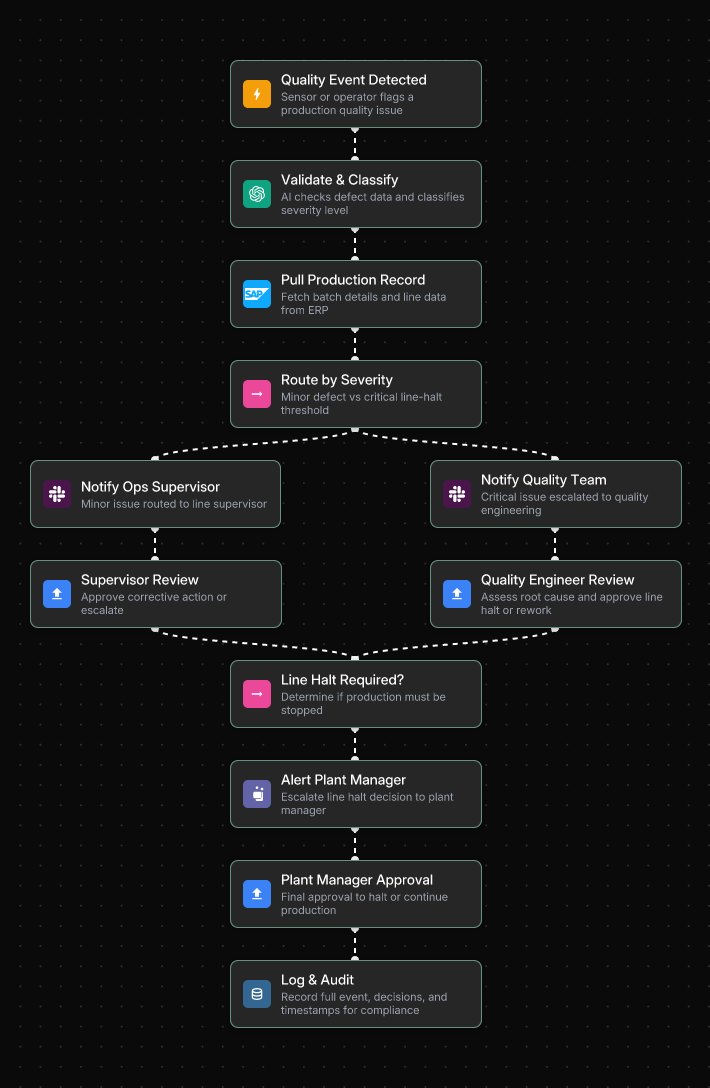
Minor defects are resolved at the supervisor level without disrupting production. Critical issues trigger quality engineering review and, if necessary, a plant manager decision on whether to halt the line — with every step logged automatically for compliance.
Pilot Strategy
Start with one specific product line or defect type. Proving ROI on a small scale builds the internal case far better than a sweeping rollout. A plan for continuous model retraining as new product variants is introduced — the model that works today needs regular updates to remain accurate as production conditions change.
→ See also: 5 Enterprise AI Manufacturing Workflows You Can Deploy in Under 30 Days
→ See also: Top 10 AI Manufacturing Tools for Production Optimization in 2026
5. Production Planning & Scheduling Automation
Static spreadsheet-based production schedules have a fundamental problem: they're obsolete before they're issued. The machine runs slowly. The material arrives late. An operator calls in sick. By the time the schedule reaches the floor, reality has already diverged from the plan.
AI-Powered Master Production Scheduling
An AI-driven scheduling workflow continuously optimizes the Master Production Schedule based on real-time constraints — open orders, machine availability, material stock, and updated demand signals. When a deviation is detected on the floor, the system recalculates the optimal schedule and pushes an update back to the MES automatically.
The workflow architecture that makes this work without disrupting existing systems: your legacy MES fires a webhook to a workflow API endpoint. The workflow runs the optimization, returns an updated schedule, and writes it back to the MES. The MES doesn't need to "know" about AI — it just calls an endpoint and receives a result.
Production efficiency improvements of 15–25% are consistent benchmarks for manufacturers who'veimplemented this approach, along with significant reductions in machine idle time.
Below is an example of a production planning workflow built in Jinba Flow — pulling live ERP data, checking capacity thresholds, auto-generating plans within normal parameters, and escalating to the Planning Director when director-level approval is needed:
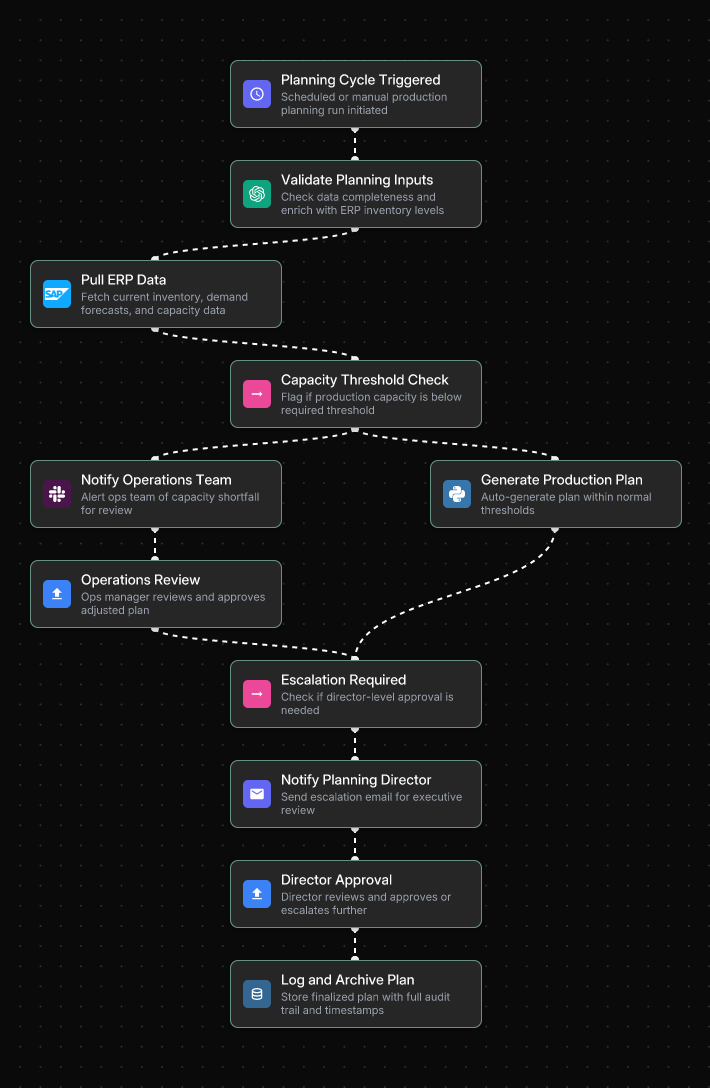
When production capacity is within normal thresholds, the plan is generated and archived automatically. When a capacity shortfall is detected, the operations team is notified immediately — and the director receives an escalation for review before the plan is finalized.
Here is a second example showing how a weekly production schedule is optimized and distributed in Jinba Flow — AI analyzes resource allocation, validates constraints, and routes capacity issues to the operations manager before distributing the final schedule:
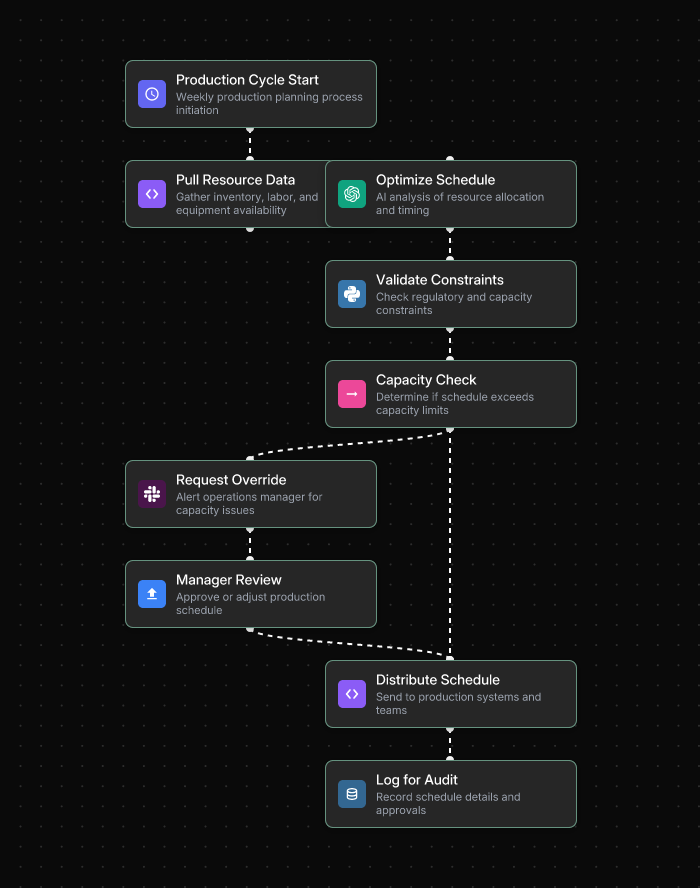
When the schedule stays within capacity limits, it is distributed to production systems and teams automatically. When capacity is exceeded, the operations manager receives an alert and approves an adjusted plan — ensuring no schedule goes live without human sign-off on exceptions.
Demand Forecasting and Inventory Optimization
AI forecasting models analyze historical sales data, seasonal patterns, and external signals to generate more accurate demand predictions than traditional MRP logic. These forecasts feed directly into an optimized material requirements planning process — reducing the twin killers of production efficiency: stockouts and overproduction.
Mengniu Dairy leveraged AI to increase inventory turnover by 73% and boost overall operational efficiency by 8%. Other manufacturers have reported inventory holding cost reductions of $200,000 per year and 15% faster delivery times.
→ See also: How to Implement Manufacturing Process AI Automation in 90 Days or Less
→ See also: 5 Production Planning AI Workflows That Integrate with Legacy MES Systems
6. Supply Chain & Inventory Optimization
Supply chain disruptions don't announce themselves. By the time a stockout or delayed shipment surfaces in your ERP, it's often too late to course-correct without costly expediting or line stoppages. AI-powered supply chain visibility changes from reactive to proactive.
Real-Time Supply Chain Monitoring
An AI workflow continuously monitors key suppliers and logistics partners, cross-referencing incoming data against expected delivery schedules and inventory thresholds. When a delay is detected — or predicted based on upstream signals — the workflow automatically:
- Flags the at-risk component with the procurement team
- Identifies alternative suppliers ranked by historical delivery performance
- Adjusts the production schedule to account for the delay
- Notifies the plant manager with specific next steps
Supply chain responsiveness improvements and lead time reductions of 20–30% are consistent benchmarks. Better inventory turnover and reduced carrying costs for overstock follow directly from better demand visibility.
Automated Remittance and Supplier Communication
Beyond monitoring, AI workflows can automate the routine supplier communication that consumes AR and procurement team time: order confirmations, delivery schedule updates, payment status notifications. Automating this layer frees procurement professionals to focus on strategic supplier relationships rather than status emails.
→ See also: 5 Manufacturing AI Tools That Integrate with Legacy Systems
→ See also: 7 Ways AI Automation is Transforming Manufacturing Workflows in 2026
7. Worker Safety & Knowledge Management
"We are not automating anything — we are helping to reduce human mistakes." That's the right frame for AI in manufacturing safety. The goal isn't an autonomous operation. It's giving every worker faster access to the right information at the right moment and catching safety deviations before they become incidents.
Safety Incident Management Automation
After a safety incident, the root cause analysis process is often manual, slow, and inconsistent. Reports sit in inboxes; patterns go unnoticed, and the same types of incidents recur because the underlying causes were never properly surfaced.
An automated incident workflow changes this: when a near-miss is logged via a digital form, the workflow instantly notifies the safety manager, logs the event for root cause analysis, schedules a review, and uses NLP to cluster the incident with similar past events. Safety managers receive a pre-packaged analysis rather than starting from scratch — and recurring patterns surface before they become serious incidents.
One factory implementing an AI monitoring system cut workplace accidents by 40%, saving $150,000 annually in compensation claims.
Knowledge Management and SOP Automation
Tacit knowledge — the institutional expertise that experienced operators accumulate over the years — is the most valuable and most at-risk asset in any manufacturing operation. When a 20-year machinist retires, they take with them an intuition for machine behavior and assembly tricks that never made it into any manual.
AI workflow platforms address this by making knowledge capture frictionless. An expert can describe their process in plain language, and the platform generates a structured, executable workflow automatically — capturing the "how" directly from the source without requiring the expert to write documentation they hate writing.
Visual work instructions improve information retention by up to 80% compared to text-heavy documents. Manufacturers adopting visual instructions report a 30% decrease in errors related to assembly tasks, and onboarding time reductions of up to 80%.
The following workflow shows how quality issues are documented and fed back into the knowledge base in Jinba Flow — capturing production data, creating a resolution case, and updating the knowledge base so future operators can access the same insight:
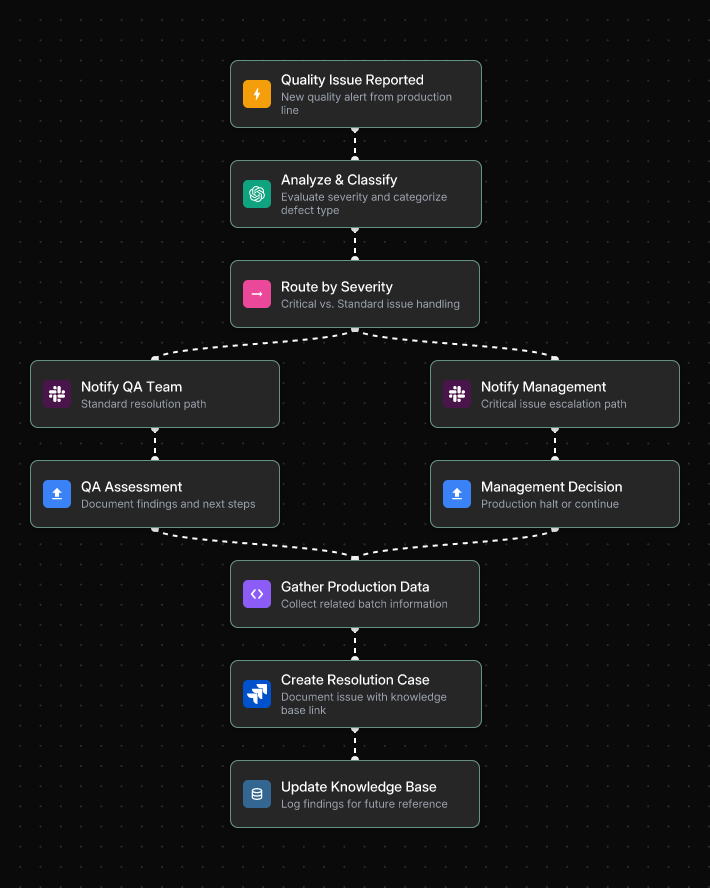
Every resolved quality issue becomes institutional knowledge — documented with batch data, linked to the knowledge base, and available to every operator on the floor. The expertise of experienced workers is captured automatically, rather than walking out the door when they retire.
→ See also: 5 Ways Knowledge Management for Manufacturing Reduces Production Errors
→ See also: Integrating Manufacturing AI Chatbots With Existing Systems: A Technical Guide
8. Security & Governance Architecture
Manufacturing environments handle sensitive operational data — CAD files, BOMs, production schedules, supplier contracts, and proprietary process parameters. Any AI automation platform must meet the security requirements for these data demands, particularly for manufacturers with CUI (Controlled Unclassified Information) or ITAR obligations.
Enterprise Security Requirements
- SOC 2 Type II compliance: Demonstrates security controls operating consistently over time — the baseline requirement for Fortune 500 manufacturers and their supply chain partners.
- On-premises and private cloud hosting: Production data — machine parameters, quality records, supplier terms — cannot be routed through shared public infrastructure. Private deployment keeps sensitive operational data within your controlled perimeter.
- SSO + RBAC: Plant supervisors execute workflows without being able to modify them. Solution engineers design integrations without accessing production data. Every role has exactly the access it needs.
- Immutable audit logging: Every workflow execution logged automatically — inputs, outputs, decision branches, timestamps. Essential for regulated manufacturing environments and quality management systems.
- Private AI model hosting: Via AWS Bedrock, Azure AI, or self-hosted models. Proprietary production data and process parameters never pass through a public AI API.
The Air-Gapped Environment Challenge
Many manufacturing environments operate in air-gapped or highly restricted network environments for security or regulatory reasons. Modern workflow automation platforms address this through on-premises deployment options that keep all processing within the facility network — no cloud dependency required. The workflow logic runs locally, integrates with local systems, and deploys local API endpoints that on-site tools can call without any external connectivity.
Below is an example of how sensitive operational data access is governed in Jinba Flow — classifying requests by sensitivity level, applying the appropriate approval path, and generating a comprehensive audit log for every access event:
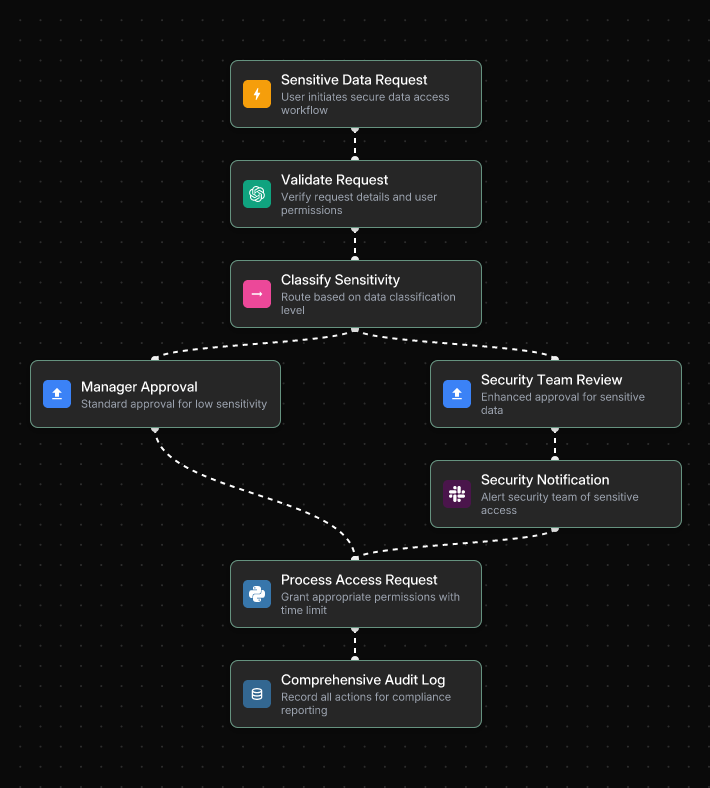
Standard data requests receive manager approval and proceed automatically. Sensitive production data — proprietary process parameters, CAD files, supplier terms — triggers an additional security team review before access is granted, ensuring every access is documented and approved.
→ See also: AI Workflow Automation for Regulated Industries: Compliance Guide
→ See also: Top 5 SOC 2 Workflow Automation Tools for Enterprise
9. Implementation Roadmap
The manufacturers succeeding with AI automation share one consistent characteristic: they start with a single, high visibility use case, prove the value, and expand systematically. Trying to automate the entire factory floor at once consistently fails.
- Phase 1 — Data readiness and use case selection (Weeks 1–6): Conduct a data quality audit before building anything. Identify your highest-cost, most measurable pain point. Predictive maintenance is the most common first deployment — unplanned downtime is universal, costly, and directly measurable. Document the current process, establish baseline metrics.
- Phase 2 — Build and pilot (Weeks 7–13): Describe the workflow in plain language to generate an initial draft automatically. Refine in the visual editor — connect sensor APIs, configure anomaly thresholds, set escalation rules. Test against real operational data. Pilot on one production line or one class of equipment before expanding. Change management starts here: frame AI as eliminatingtedious monitoring work, not replacing expertise.
- Phase 3 — Deploy and measure (Weeks 14–20): Publish as a production-ready API endpoint. Your legacy MES or CMMS calls the workflow — no migration required. Track uptime improvement, defect reduction, or schedule adherence depending on your use case. Use early results to build the business case for expansion.
- Phase 4 — Scale (Weeks 21+): Expand additional equipment, production lines, or operational functions. Integrate additional data sources. Establish quarterly model retraining and workflow optimization cadence. Each deployed workflow compounds the efficiency gains of the previous ones.
→ See also: How to Implement Manufacturing Process AI Automation in 90 Days or Less
→ See also: 5 Enterprise AI Manufacturing Workflows You Can Deploy in Under 30 Days
10. Getting Started with Jinba Flow
Jinba Flow is a YC-backed, SOC II compliant AI workflow builder purpose-built for Fortune 500 enterprises. With over 40,000 enterprise users running automated workflows daily, it's designed for exactly the challenge manufacturing IT teams face: connecting modern AI capabilities to legacy systems without a costly infrastructure overhaul.
Why Jinba for Manufacturing Automation
- Chat-to-Flow Generation: Describe your maintenance alert or quality control workflow in plain language — "When a vibration sensor on Assembly Line 3 exceeds its threshold for 5 minutes, create a work order in our CMMS and send an alert to the maintenance team" — and Jinbagenerates a deployable workflow draft automatically. No developer is required.
- Visual Workflow Editor: Every sensor trigger, every conditional branch, every system integration visible as a flowchart. Solution engineers can validate integration points. Operations staff can understand the logic. No black boxes.
- Deploy as API or MCP Server: Workflows are published as reusable endpoints. Your legacy MES calls the maintenance workflow as an API — no migration, no rebuilding. Legacy systems stay intact; the intelligence layer sits on top.
- API wrappers for legacy systems: For systems without modern APIs, Jinba Flow creates digital wrappers that make legacy system data accessible to modern AI tools — without touching the underlying infrastructure.
- Jinba App for non-technical execution: Plant supervisors, maintenance leads, and quality managers execute approved workflows through a simple chat interface. No complex dashboards. No risk of modifying workflow logic.
- SOC 2 + private hosting: On-prem and private cloud deployment. Private model hosting via AWS Bedrock, Azure AI, or self-hosted. Proprietary production data never touches a public API. Air-gapped environments are supported.
Your First Workflow to Build
Start with predictive maintenance alerting for a single class of critical equipment — high value, measurable ROI, and a contained scope for a first deployment. From there: quality control defect routing, production schedule optimization, supply chain monitoring, and safety incident management.
The manufacturers leading in the next decade aren't the ones who automated everything at once. They're the ones who built one governed, measurable workflow, proved the value, and scaled from there.
Frequently Asked Questions
What is manufacturing AI automation?
Manufacturing AI automation uses artificial intelligence and workflow software to handle the data-intensive, repetitive tasks across factory operations — monitoring equipment health, detecting quality defects, optimizing production schedules, and managing supply chain signals — without manual intervention for standard cases. The goal is not to replace experienced operators and engineers but to give them faster access to the right information so they can focus on the complex decisions that require their expertise.
Do I need to replace my legacy systems with AI?
No. The most effective approach is an intelligent middleware layer that wraps your existing MES, ERP, and legacy machines in modern API capabilities, handling data in both directions without touching the core infrastructure. Your legacy systems stay intact. The AI workflow sits on top, calling your systems via API and returning enriched decisions — no migration required.
How does AI predictive maintenance work?
AI predictive maintenance analyzes real-time sensor data — vibration, temperature, pressure — against historical machine behavior to generate failure probability scores. When the score crosses a defined threshold, an automated workflow creates a maintenance work order, schedules the repair during the next planned production stop, and notifies the relevant technician. This shifts maintenance from reactive firefighting to data-backed planning, reducing unplanned downtime by 30–50%.
What is the ROI for manufacturing AI automation?
ROI varies by use case. Predictive maintenance delivers 30–50% reduction in unplanned downtime and 25%+ maintenance cost savings. Quality control automation reduces defect rates by 40%+ and can save $1M+ annually in reduced scrap and rework. Production planning AI improves efficiency by 15–25%. Supply chain optimization has delivered inventory turnover improvements of up to 73%. The highest ROI consistently comes from targeting a specific, high-cost pain point rather than broad automation.
How do I handle AI integration with air-gapped manufacturing environments?
On-premises deployment keeps all AI processing within the facility's network — no cloud connectivity required. Workflow logic runs locally, integrates with local systems via local API endpoints, and never transmits sensitive production data outside the facility perimeter. Modern workflow automation platforms explicitly support air-gapped deployment for manufacturers with strict data residency or security requirements.
What data do I need to get started with manufacturing AI?
The specific data needed depends on the use case. Predictive maintenance requires historical sensor data and maintenance logs. Quality control needs labeled image datasets of good and defective parts. Production planning requires order data, machine availability records, and historical production rates. The most important first step is a data readiness audit — identifying what data exists, how clean it is, and whether it's accessible. Starting with a narrow, well-understood dataset consistently outperforms trying to integrate everything at once.
The Bottom Line
The manufacturers winning the next decade aren't the ones who replaced everything — they're the ones who built smarter connections between what they already have. The AI tools to do this exist today. The integration patterns are proven. The ROI is measurable.
The barrier isn't technology. It's the approach: starting too broad, skipping data readiness, automating without governance, and underestimating the human adoption challenge. The manufacturers who get this right start narrowing, proving the value at a small scale, and expand systematically — building an intelligent automation layer on top of their existing infrastructure rather than replacing it.
Start with one workflow. Measure the impact. Built from there.